Updated August 9, 2026 · 8 min read
By Boise Bath — bathroom & shower remodeling in Boise & the Treasure Valley
The short answer
A double shower is one wide enough for two people to use at once, typically 60 inches or more on the long side with two independently controlled heads. Past roughly 60 by 36 inches, the drainage, glass weight, ventilation and hot water capacity all change — which is what makes it a build decision rather than a fixture upgrade.
Key takeaways
- Two heads do not make a double shower. The defining measure is width — around 60 inches minimum, with 72 inches and up being where two people genuinely stop negotiating for space.
- Three layouts dominate: heads on opposing walls, heads on adjacent walls, and both on one wall. Opposing walls gives the most independence and needs the most width.
- Each head should have its own valve. Sharing one means neither person controls their own temperature, which is the most common regret at this size.
- Wide showers often outgrow a single centre drain. A linear drain or a second drain keeps the floor slope shallow enough to stay comfortable underfoot.
- Larger glass panels get heavy fast, and the framing behind the walls has to be planned for that before tile goes on — not after.
- Two heads running together can outpace a standard water heater, which is a capacity question worth answering during design rather than on the first cold morning.
What actually counts as a double shower
The term gets used for two different things, and they are not the same purchase. Adding a second showerhead to an existing stall gives you two places to stand under water in a space still built for one person. A double shower is a shower sized so two people can use it at the same time without either one stepping out of the spray to let the other past.
The dividing line is width, not fixture count. As a reference point, the IRC sets a 30-by-30-inch minimum finished interior for any shower and the NKBA recommends 36 by 36 inches as a comfortable single. A shower meant for two generally starts around 60 inches on the long side, and the ones people describe as genuinely comfortable tend to run 72 inches or more.
Depth matters as much as width and gets overlooked. A shower that is 72 inches wide but only 32 inches deep is a corridor — you can stand side by side but not move around each other. Around 42 to 48 inches of depth is where the room starts to feel like a room.
The useful test
Can both people be under water at once, with the door closed, without anyone stepping out of the spray to move? That is a double shower. Anything less is a second showerhead.
The three layouts
Almost every double shower resolves into one of three arrangements, and the choice affects far more than where the fixtures land.
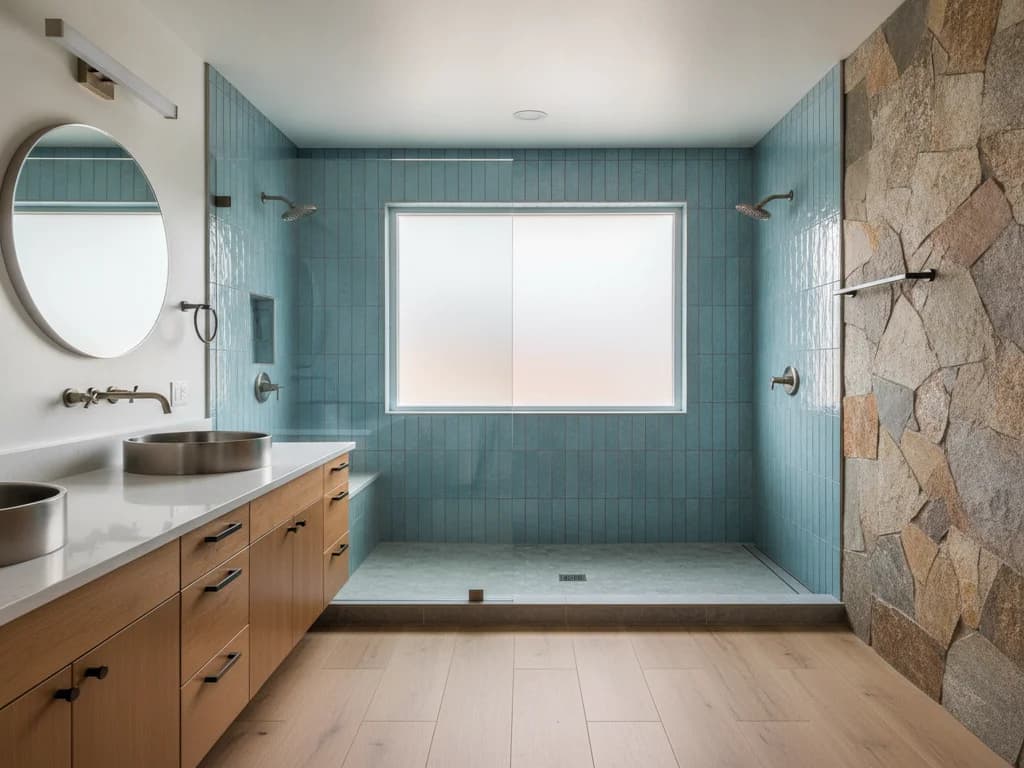
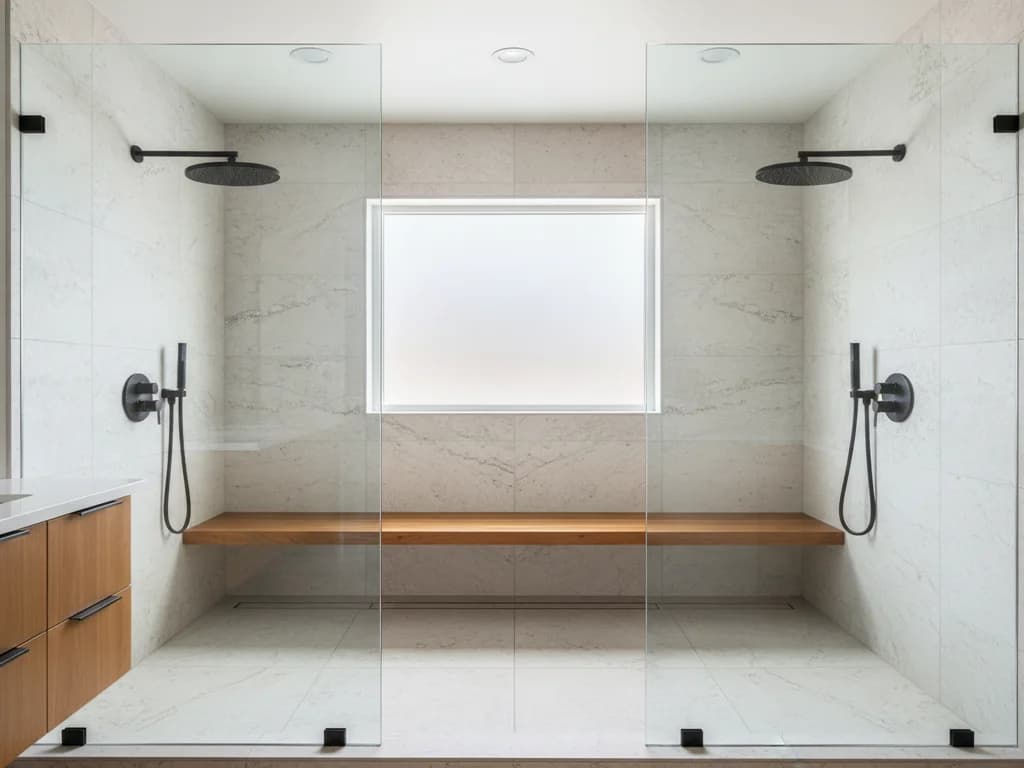
Opposing walls. The two heads face each other from either end. This gives each person the most independence and the clearest sense of their own space, and it is the layout that most benefits from real width — under about 72 inches the two spray zones start to overlap and the advantage disappears.
Adjacent walls. Heads on walls that meet at a corner. This works well in a squarer footprint and keeps both users away from the door, but it needs care in planning so one person is not showering into the other's path to the entry.
Both on one wall. The most economical to build, because all the valves and supply run in a single wet wall. It is the least private of the three and it wants generous width to avoid feeling like a queue, but it is the easiest to retrofit into an existing footprint and often the most sensible choice.
Give each head its own valve
This is the detail that separates a double shower people love from one they quietly stop using together, and it is decided long before tile goes up.
If both heads run off a single valve, the two of you share one temperature and one flow setting. One person adjusts and the other is affected. Two independent valves — often described as two separate shower "zones" — mean each person controls their own water. The plumbing is more involved and it costs more, and it is close to the only thing at this size that nobody regrets paying for.
It also changes what the room can do later. Independent zones make it straightforward to run just one side for an ordinary weekday shower, rather than heating and draining a space built for two every morning.
What changes at that size
The interesting part of a big shower is not the tile. It is the four systems that all shift once the footprint grows, and none of them are visible in a finished photograph.
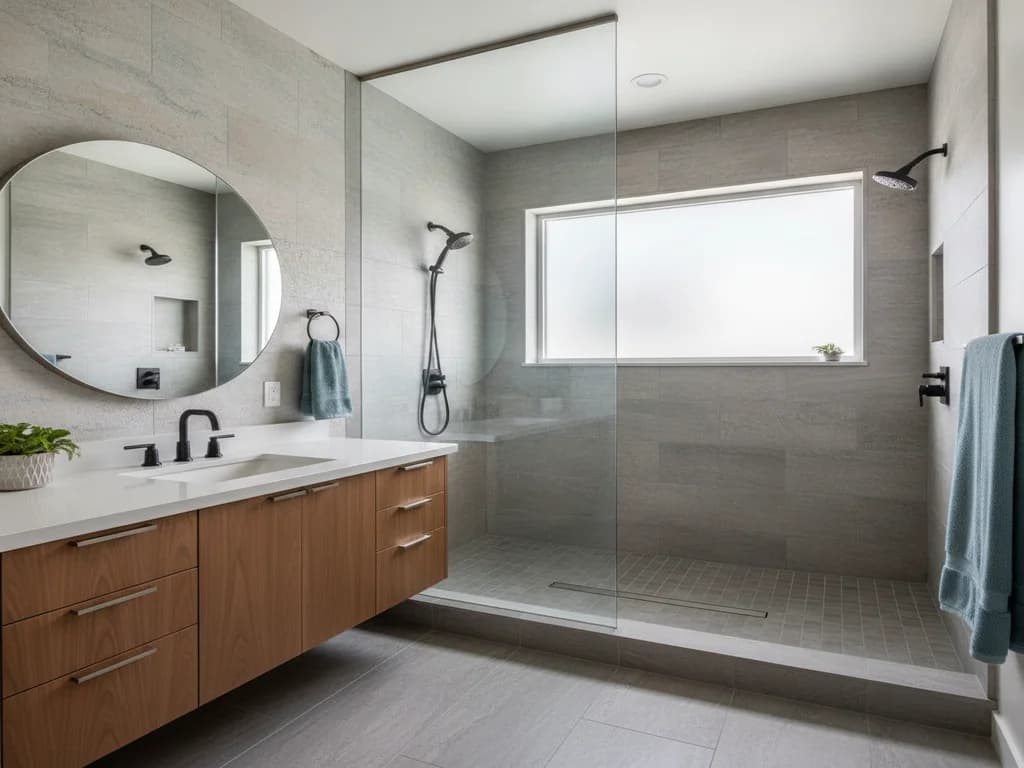
- Drainage. A single centre drain in a wide floor forces a steeper slope from the far corners to keep water moving, and steep slope under bare feet feels wrong. A linear drain along one wall, or a second drain, lets the floor stay closer to flat while still draining properly.
- Waterproofing area. A larger wet area means more square footage of membrane, more corners, and more transitions to get right. This is the layer that decides whether the room lasts, and it scales directly with size.
- Glass weight. Big frameless panels are heavy. The wall framing behind the tile has to be blocked to carry the hinges and supports, which is a decision made during framing — retrofitting support behind finished tile is not a small job.
- Ventilation. Two heads produce roughly twice the moisture. An exhaust fan sized for the old bathroom will not keep up, and under-ventilating a big shower is how mirrors stay fogged and grout stays damp.
- Hot water. Two heads running simultaneously can draw more than a standard tank delivers. Whether that means a larger tank, a different water heater, or simply knowing the limit, it is a question to answer during design.
Benches, niches and the things you notice daily
A shower this size has room for the details that a small one cannot spare, and they are worth planning rather than adding wherever they fit.
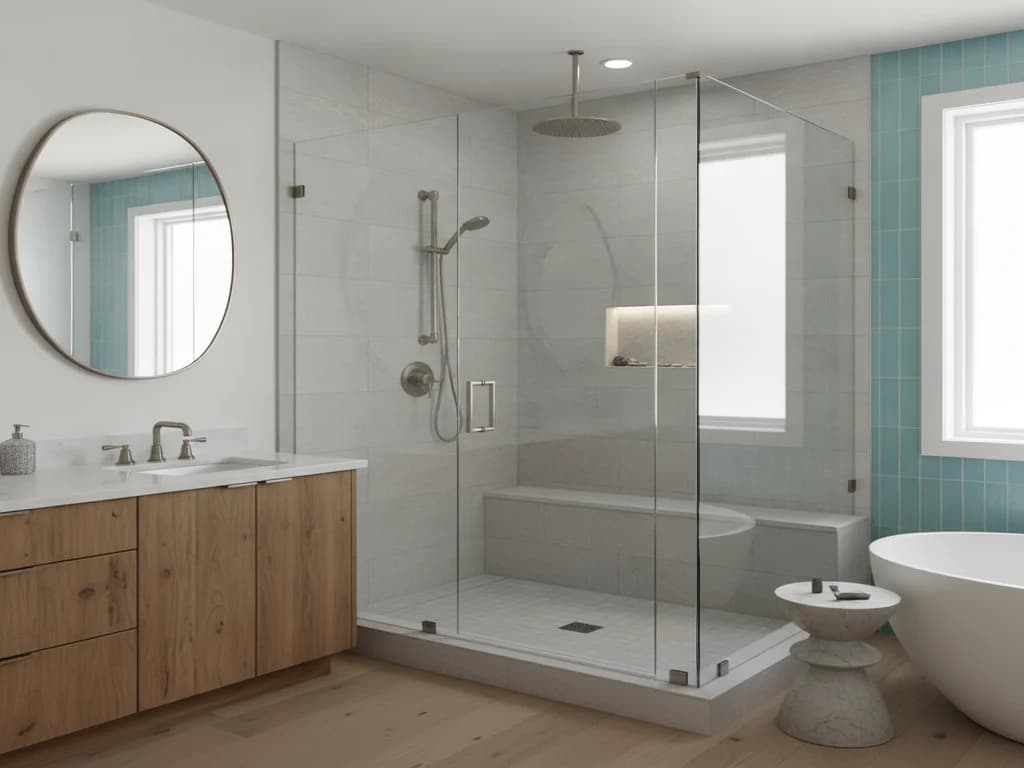
A bench works best on an end wall, out of the direct spray of both heads, where it can be full-depth without narrowing the walking space. In a double shower it earns its place more than in a single, because there is somewhere to put it that does not cost anyone their standing room.
Niches should be reachable from each side rather than shared in the middle, which usually means one per head. In a wide shower a single central niche means one person is always reaching across the other.
Two heads also means two sets of controls to reach without walking into cold water. Valves belong near the entry side of each zone, not directly under the head — a small point that is obvious the first winter and impossible to change afterwards.
Is it worth it?
Honestly, sometimes not. A double shower takes real square footage, and in a bathroom that is already tight, those inches usually do more good as storage, a wider vanity, or simply floor space. If building one means the rest of the room gets cramped, it is the wrong trade.
Where it does earn its place is in a primary bathroom with the footprint to spare, particularly when two people genuinely get ready at the same time. It also solves an accessibility problem quietly: a shower sized for two is a shower with room for someone to assist, or for a seat and a helper, without ever being described as a medical fixture.
For how shower size is decided more generally, see our walk-in shower dimensions guide, and if the constraint is finding the space at all, where the extra inches come from is the place to start. Boise Bath builds these as walk-in showers — the published range and what moves it are in our walk-in shower cost guide.
Ready to plan your Boise bathroom?
Licensed & insured · 3-year workmanship warranty
Frequently asked questions
- How big does a double shower need to be?
- Around 60 inches on the long side is the practical minimum, and 72 inches or more is where two people stop negotiating for space. Depth matters just as much: 42 to 48 inches lets people move past each other, while a deep-but-narrow shower feels like a corridor no matter how wide it is.
- Do you need two valves for two shower heads?
- You do not need them, but it is the detail people most often wish they had paid for. On a single valve both heads share one temperature and flow, so one person adjusting affects the other. Independent valves let each person control their own water and let you run one side alone on an ordinary morning.
- Does a double shower need a bigger drain?
- Not necessarily a larger drain, but often a different one. A single centre drain in a wide floor requires a steeper slope from the far corners, which feels awkward underfoot. A linear drain along one wall, or a second drain, keeps the floor closer to flat while still moving water properly.
- Will my water heater keep up with two shower heads?
- It may not. Two heads running at once draw considerably more hot water than one, and a tank sized for the previous bathroom can run short. This is worth checking during design, when a larger tank or a different water heater is still an easy change rather than a discovery you make on a cold morning.
- Is a double shower better than a tub?
- It depends on the household rather than the fixture. A double shower is used far more often in most homes, but removing the only bathtub in the house is a decision worth thinking through separately, particularly with young children or resale in mind. Many primary bathrooms with the room end up with both.
- Can you convert an existing shower into a double?
- Sometimes, if the footprint can grow — typically by absorbing a tub, a closet, or a non-bearing wall. The shower itself is rebuilt regardless, since the pan, waterproofing and often the drain are all new. Whether the space exists is a floor-plan question, answered by measuring the room rather than the stall.
Sources
- International Code Council (IRC/IBC)
- National Kitchen & Bath Association (NKBA)
- Tile Council of North America (TCNA)
- ENERGY STAR — Ventilating Fans
- U.S. Access Board — ADA Accessibility Standards
Claims and figures are drawn from the sources above and provided for general guidance; your project may vary. Photography is illustrative of design concepts. For a fixed price on your specific bathroom, request a free estimate.